
CAT 395 vs. Komatsu PC1250: Mining Excavator Sourcing & TCO Analysis (2026)
Compare CAT 395 vs Komatsu PC1250 mining excavators in 2026. This guide analyzes specifications, productivity, fuel efficiency, maintenance costs, and total cost of ownership (TCO) to help mining engineers choose the right equipment for long-term performance.

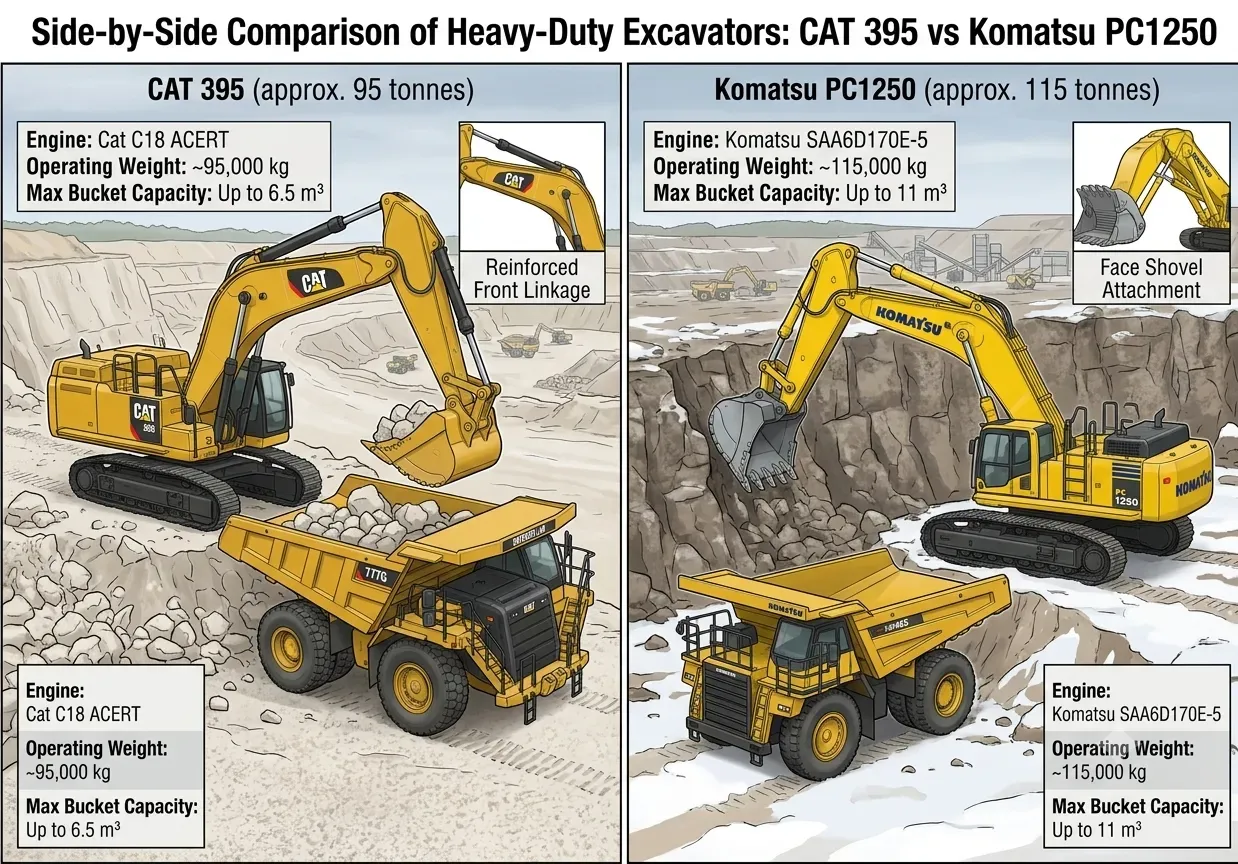
When designing a quarry layout or configuring an open-pit fleet, choosing between a 95-ton CAT 395 and a 125-ton Komatsu PC1250 is not a simple weight comparison. It is a decision about your hauling fleet's cycle times and loading pass matches.
If you are running a fleet of 40-ton to 60-ton trucks (like the Cat 770 or 772), the Cat 395 is your sweet spot, achieving a perfect 3-to-4 pass match. However, if your production relies on 90-ton class rigid haulers (like the Komatsu HD785), stepping up to the PC1250 is mandatory to avoid "truck queuing" and keep your cycle times under 3.5 minutes.
Deep Dive Analysis: CAT 395 vs. Komatsu PC1250 Mining Excavator Selection
Mining excavator sourcing decisions in 2026 are increasingly focused on productivity per operating hour rather than initial purchase price alone. Both the CAT 395 and Komatsu PC1250 are designed for heavy-duty excavation, but they target different segments of the mining market.
The CAT 395 is a large hydraulic excavator positioned between traditional construction excavators and ultra-class mining machines. It is commonly used in quarrying, infrastructure projects, overburden removal, and medium-scale mining operations.
The Komatsu PC1250 belongs to the ultra-large mining excavator category and is engineered specifically for continuous high-volume production in open-pit mines.

CAT 395 Key Characteristics
The CAT 395 offers several advantages for contractors and mining companies requiring mobility and operational flexibility:
- Operating weight: Approximately 94–96 metric tons depending on configuration
- Engine power: Around 405 kW (543 hp)
- Bucket capacity: Approximately 4.5–6.5 m³ depending on application
- Hydraulic system: High-pressure hydraulic system optimized for faster cycle times
- Primary applications:
- Quarry operations
- Aggregate production
- Medium-scale mining
- Large earthmoving projects
The CAT 395 benefits from Caterpillar’s global dealer network, making parts supply and field support easier in many regions.
Its compact size compared with ultra-class excavators also reduces transportation challenges. A company operating multiple smaller mine sites may achieve better fleet flexibility by selecting CAT 395 units.

Komatsu PC1250 Key Characteristics
The Komatsu PC1250 is designed for maximum productivity in demanding mining environments.
Key specifications include:
- Operating weight: Approximately 124–130 metric tons
- Engine power: Around 578 kW (775 hp)
- Bucket capacity: Approximately 6.7–7.5 m³
- Hydraulic system: Large-capacity hydraulic pumps designed for high-volume material handling
- Primary applications:
- Open-pit mining
- Iron ore operations
- Copper mines
- Large coal mining projects
- High-production stripping operations
The PC1250 is optimized for pairing with large mining trucks. Its larger bucket capacity allows fewer loading cycles, improving truck utilization and reducing overall fleet operating costs.
Heavy Equipment Benchmarking: Engine & Hydraulic Systems
To evaluate these giants, we must look at how they manage hydraulic power. The Cat 395 utilizes a high-flow, electronically controlled hydraulic system to achieve lightning-fast cycle times, while Komatsu relies on its time-tested, high-displacement low-RPM torque.
| Metric | Caterpillar 395 | Komatsu PC1250-11 |
|---|---|---|
| Operating Weight | 94,000 kg (207,200 lb) | 120,500 kg (265,650 lb) |
| Engine Model | Cat C18 | Komatsu SAA6D170E-7 |
| Flywheel Power | 543 HP (405 kW) @ 1800 rpm | 775 HP (578 kW) @ 1800 rpm |
| Max Hydraulic Flow | 2 x 540 L/min (285 gpm) | 2 x 494 L/min + 1 x 600 L/min |
| Bucket Breakout Force | 497 kN (111,730 lbf) | 474 kN (106,560 lbf) |
| Swing Torque | 358,000 N·m (Heavy lift mode) | 398,000 N·m |
| Est. Fuel Burn (Heavy Dig) | 55 – 70 L/hr (14.5 - 18.5 gal/hr) | 78 – 95 L/hr (20.6 - 25.1 gal/hr) |
Final Sourcing Verdict: Which Machine Secures Your ROI?
After calculating the TCO and analyzing the structural durability of both platforms, the decision tree is clear:
Buy the CAT 395 if:
- Your haul truck fleet consists of 40-to-60-ton utility trucks. Pairing a 95-ton excavator with smaller trucks prevents under-loading and maximizes fuel efficiency.
- You operate across multiple temporary sites. The Cat 395 can be decommissioned, transported, and reassembled in 48 hours without specialized heavy-haul escort teams in most regions.
- Operators are scarce in your area. Cat’s Grade with 2D, Payload, and Lift Assist technologies dramatically lower the skill barrier for operators, maintaining 90% efficiency even with less-experienced drivers.
Buy the Komatsu PC1250 if:
- You are loading 90-ton rigid trucks (e.g., Cat 777 or Komatsu HD785). The 7.0 m³ bucket delivers a perfect 4-pass match, reducing truck cycle times by up to 25%.
- The material is highly abrasive, unblasted rock. The PC1250's cast steel undercarriage joints, thicker carbody, and superior structural weight offer the high stability needed to pry out tough rock faces without tipping or premature track frame cracking.
- You run a 24/7 continuous double-shift operation. The Komatsu's heavy-duty dual-filtration and simplified mechanical layout are specifically designed for continuous, high-hour mining duty cycles.
Comparison/Data Table: CAT 395 vs. Komatsu PC1250
| Parameter | CAT 395 | Komatsu PC1250 |
|---|---|---|
| Machine Class | Large hydraulic excavator | Ultra-large mining excavator |
| Operating Weight | ~95 tons | ~125 tons |
| Engine Power | ~543 hp | ~775 hp |
| Bucket Capacity | 4.5–6.5 m³ | 6.7–7.5 m³ |
| Main Application | Quarry, construction, medium mining | Large-scale mining |
| Productivity Level | High | Very high |
| Fuel Consumption | Lower absolute consumption | Higher but better output per ton |
| Transportation Difficulty | Easier | Requires specialized transport |
| Initial Purchase Cost | Lower | Higher |
| Maintenance Complexity | Moderate | High |
| Dealer Support | Excellent global coverage | Strong global mining support |
| Recommended Mine Scale | Small to medium operations | Large open-pit mines |
Total Cost of Ownership (TCO) Analysis
The purchase price is only one part of excavator economics. A proper mining equipment evaluation should include:
1. Initial Investment Cost
The CAT 395 typically requires a lower upfront investment compared with the Komatsu PC1250.
Advantages:
- Lower capital expenditure
- Easier financing
- Faster deployment
- Lower transportation cost
However, the PC1250’s higher productivity can offset its higher purchase price in large mining operations.
2. Fuel Efficiency and Production Cost
Fuel consumption must be evaluated based on cost per cubic meter of material moved.
A larger excavator does not automatically mean higher operating cost.
For example:
- CAT 395 may consume less fuel per hour.
- PC1250 may consume more fuel but move significantly more material per hour.
The correct calculation is:
Cost per ton = (Fuel + Maintenance + Labor + Depreciation) ÷ Material Produced
For high-volume mines, the PC1250 often achieves a lower cost per ton because fewer machines are required to reach production targets.
The CAT 395 features advanced electronic hydraulics (Next Gen system) designed specifically to lower fuel burn per hour compared to older models. The Komatsu PC1250 relies on higher displacement and pure hydraulic force to move massive amounts of material.
| Metric | Caterpillar 395 (95 Ton) | Komatsu PC1250-8R (115-120 Ton) |
| Engine Model | Cat C18 | Komatsu SAA6D170E-5 |
| Gross Power | 543 hp (405 kW) | 672 hp (501 kW) |
| Avg. Fuel Burn (Medium Duty) | 45 – 55 Liters/hr (12–14.5 Gal/hr) | 65 – 80 Liters/hr (17–21 Gal/hr) |
| Avg. Fuel Burn (Heavy Rock/Mining) | 60 – 75 Liters/hr (16–20 Gal/hr) | 85 – 110 Liters/hr (22.5–29 Gal/hr) |
| Technology Focus | Hydrostatic fan & Electro-hydraulic valves: Drastically cuts parasitic engine load when idling or during light swing cycles. | High Displacement Power: Maximizes bucket breakout force ($413 \text{ kN}$ vs Cat's $362 \text{ kN}$), but burns constant fuel to maintain high hydraulic pressure. |
Winner on Fuel Efficiency (Liters per Hour): CAT 395. It burns roughly 25% to 35% less fuel per operating hour than the PC1250 under identical heavy-duty cycles.
3. Maintenance and Component Life
Mining environments create severe stress on:
- Hydraulic pumps
- Swing systems
- Undercarriage components
- Boom and arm structures
- Final drives
CAT 395 advantages:
- Large global service network
- Easier access to replacement parts
- More technicians familiar with the platform
Komatsu PC1250 advantages:
- Heavy-duty structural design
- Designed specifically for mining duty cycles
- Longer service intervals in certain high-production applications
A proper maintenance plan should include:
- Oil sampling programs
- Hydraulic contamination monitoring
- Undercarriage inspections
- Scheduled component replacement planning
Maintenance & Lifecycle Comparison Table
| Feature / Metric | Caterpillar 395 (95-Ton) | Komatsu PC1250-8R (115/120-Ton) |
| Engine Overhaul Life (TBO) | 18,000 – 22,000 hours (Cat C18) | 20,000 – 25,000 hours (Komatsu SAA6D170E-5) |
| Hydraulic Pump Life | 12,000 – 15,000 hours | 14,000 – 16,000 hours |
| Undercarriage Life (Standard Rock) | 5,000 – 7,000 hours | 6,000 – 8,000 hours (Heavier tracks) |
| Engine Oil & Filter Interval | 1,000 hours (Under strict oil sampling) | 500 hours |
| Hydraulic Oil Filter Interval | 3,000 hours | 1,000 hours |
| Fuel Filter Replacement Interval | 1,000 hours | 500 hours |
| Greasing System | Auto-Lube Standard: Factory integrated, programmable via display. | Auto-Lube Optional / Manual Block: Requires frequent manual checks if not retrofitted. |
| Diagnostics & Telematics | Advanced Electronic (Cat Product Link): Pre-fault remote tracking; localized sensor alerts. | Mechanical/Hydraulic Gauge Heavy (KOMTRAX Plus): Solid satellite data, but needs physical pressure testing for deep hydraulic faults. |
| Structural / Boom Welding Risks | Low. Stress-relieved heavy-duty plates; smart swing dampening prevents frame cracking. | Moderate. High breakout force can cause stress fractures at the boom foot/stick nose after 12,000+ hrs. |
Key Takeaways on Component Lifecycles
1. Routine Maintenance Cost Winner: CAT 395
Caterpillar engineered the Next Gen line to dramatically slash PM (Preventative Maintenance) costs. By stretching the engine oil, fuel, and hydraulic filters out to 1,000 and 3,000 hours, the CAT 395 cuts total maintenance fluid/filter consumption by roughly 40-50% over its lifetime compared to the PC1250-8R.
2. Brute Reliability & Engine Longevity Winner: Komatsu PC1250-8R
The Komatsu 170-series engine is massive, high-displacement ($23.15 \text{ L}$ vs. Cat’s $18.1 \text{ L}$), and runs at a lower stress state to output its power. In continuous, 24/7 punishing mining conditions, the Komatsu engine and main pumps generally last 15-20% longer before requiring their first major rebuild, provided the 500-hour oil change schedule is strictly kept.
3. Hydraulic Complexity vs. Simplicity
- CAT 395: Uses an electro-hydraulic valve block. There are no pilot lines running into the cab, which reduces oil volume and leak points. However, if an electronic sensor or solenoid fails, it requires a technician with specialized diagnostic software (Cat ET) to troubleshoot.
- Komatsu PC1250-8R: Uses a traditional pilot-pressure system. It uses more hoses and is more prone to minor leaks or weeping over time, but any experienced heavy-equipment mechanic can troubleshoot it using standard pressure gauges without needing a laptop.
Step-by-Step Guide: How to Select the Right Mining Excavator
Step 1: Analyze Production Requirements
Before choosing a machine, calculate:
- Required tons per hour
- Number of working shifts
- Truck loading requirements
- Mine depth and excavation conditions
A PC1250 is usually justified when production targets exceed the capability of smaller excavators.
Step 2: Match Excavator Size With Truck Fleet
Excavator-truck matching is critical.
General guidelines:
- CAT 395 works well with medium mining trucks.
- Komatsu PC1250 is better matched with larger haul trucks.
Poor matching creates:
- Increased waiting time
- Lower truck utilization
- Higher fuel consumption
- Reduced mine efficiency
Step 3: Evaluate Local Support Infrastructure
Before purchasing, confirm:
- Availability of OEM technicians
- Spare parts warehouse location
- Service response time
- Hydraulic and electrical diagnostic capability
A cheaper machine without reliable support can become expensive during downtime.
Step 4: Calculate Five-Year TCO
A realistic mining equipment budget should include:
Capital Costs
- Machine purchase price
- Transportation
- Commissioning
Operating Costs
- Diesel consumption
- Lubricants
- Filters
- Wear parts
- Labor
Downtime Costs
- Production losses
- Emergency repairs
- Replacement equipment rental
Many mining companies find that a higher-capacity excavator provides better economics when operating continuously.
Step 5: Consider Future Mining Conditions
Mining conditions often change over a machine’s lifetime.
Consider:
- Increasing excavation depth
- Harder rock conditions
- Larger production targets
- Expansion plans
Buying equipment with additional capacity can reduce future replacement costs.
Conclusion
The CAT 395 and Komatsu PC1250 serve different mining strategies. The CAT 395 is a versatile, cost-effective choice for contractors and medium-scale operations requiring mobility and lower investment. The Komatsu PC1250 is better suited for large open-pit mines where maximum production and lower cost per ton are the primary objectives.
For 2026 mining equipment sourcing, companies should not select excavators based only on purchase price. A complete TCO evaluation—including fuel efficiency, maintenance support, productivity, and lifecycle costs—is essential for achieving the lowest operational cost and highest return on investment.
💬 Mining Sourcing FAQ:
CAT 395 vs. Komatsu PC1250
- Q: How many passes does it take for a CAT 395 and a Komatsu PC1250 to load a 90-ton rigid haul truck?
- A: For a 90-ton rigid hauler (like the Cat 777 or Komatsu HD785), the Komatsu PC1250 (equipped with a standard 7.0 m³ rock bucket) achieves a perfect 4-pass match, optimizing haul cycle times. The CAT 395 (equipped with a 5.5 m³ heavy-duty bucket) typically requires 5 to 6 passes to load the same truck, which can lead to truck queuing and lower fleet efficiency in high-volume operations.
- Q: What are the transport and mobilization differences between the CAT 395 and Komatsu PC1250?
- A: The 95-ton CAT 395 offers significantly lower mobilization costs as it can often be transported on a single lowboy trailer with only the counterweight and stick removed. In contrast, the 125-ton Komatsu PC1250 exceeds standard heavy-haul limits in most regions, requiring 2 to 3 truckloads (disassembling the boom, stick, counterweight, and sometimes track frames), which increases rigging, crane rental, and transport costs by up to 60%.
- Q: Which excavator has better fuel efficiency per ton of material moved?
- A: While the CAT 395 has a lower absolute fuel burn rate (55–70 L/hr), the Komatsu PC1250 offers a better fuel-to-production ratio (fuel burn per ton of moved material) in continuous, high-production open-pit mining. The PC1250's 775 HP engine paired with a larger bucket allows it to move up to 30% more material per hour, offsetting its higher absolute fuel consumption (78–95 L/hr) when operating at full capacity.
- Q: Can the CAT 395 handle unblasted rock excavation as effectively as the Komatsu PC1250?
- A: No. While the CAT 395 has an impressive bucket breakout force of 497 kN, its lower operating weight (95 tons) reduces its leverage when prying out tough, unblasted rock faces. The 125-ton Komatsu PC1250 provides a heavier, more stable footprint and higher swing torque (398,000 N·m), making it the superior choice for heavy-duty digging in high-resistance, unblasted rock formations.
Reviewed by Jason Chen, 10-year Senior Mining Fleet Consultant
Request Technical Blueprints & Factory Quotes
Submit your machinery parameters below. Connect directly with verified, certified heavy industrial manufacturers to receive custom foundation drawings, layout schematics, and direct-from-factory pricing.